
 UAE/GCC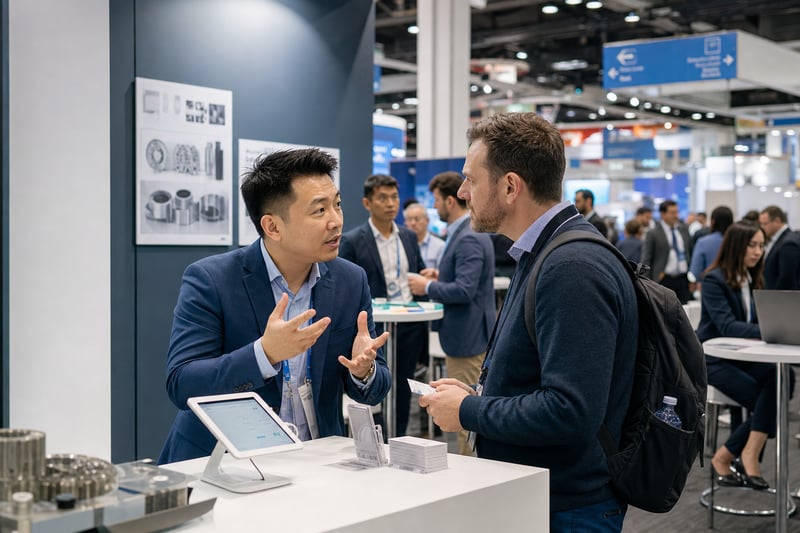
The context from every conversation you have with a lead at a trade show should be logged into the CRM as notes so that any follow up emails are relevant to that person and help them remember who you are and what you spoke about. That is the whole game. For a Chinese manufacturer trying to be seen as a brand owner rather than a faceless supplier, the follow up is often where credibility is won or lost, and most factories get it wrong. Generic follow up spam email blasts do your brand a disservice and come across as inauthentic to those you spoke with.
I have watched serious buyers walk away from capable manufacturers, not because the product was weak, but because the follow up made the company look like it did not remember the conversation. When you are moving from OEM supplier to brand, that impression is expensive. The good news is that this is fixable, and the fix is not complicated.
Why most trade show follow-up fails
I keep coming back to one statistic because it is so stark. Up to 80% of trade show leads never receive any follow-up at all, which Trade Show PRO calls the single biggest waste in trade show marketing. Think about what that means for a manufacturer. You paid for the booth, the flights, the samples, the staff, and then four out of five conversations simply die. The average cost per trade show lead runs from $100 to $300, so this is real money left on the show floor.
The failure is rarely about laziness. It is about not having a system. The person who spoke to the buyer flies home, gets buried in production issues, and the stack of business cards sits in a drawer. By the time anyone acts, the buyer has forgotten the conversation and moved on. I think of follow up as part of the product experience, because to a Western buyer evaluating whether your factory can behave like a brand, it is exactly that.
Speed decides more than you think
I would prioritise speed above almost everything else in post-event marketing, and the data backs that instinct hard. Companies that follow up within 24 hours are six to nine times more likely to convert than those who wait a week or more. On email specifically, messages sent within 24 hours achieve an average open rate around 48%, while emails sent a week after the show sit at 21%, less than half the engagement, according to research summarised by PureXhibits.
Response speed is consistently the most significant variable in lead conversion across channels, and trade show leads are no exception. For a manufacturer courting Western buyers, speed also sends a signal about how you operate. A buyer in Germany or the US who receives a relevant, specific reply the next morning quietly concludes that you are organised and responsive. One who hears nothing for ten days concludes the opposite, and that impression sticks to your brand long after the show.
Capture the context, or the lead is not real
I am blunt about this internally. If a conversation at your booth did not produce a next step, a pain point, or a target application, it was not really a qualified lead. Manufacturing Lead Generation makes the same point, noting that 92% of attendees come to see new products and 77% are looking for industry trends. They are there to solve something. Your job at the booth is to uncover what that is, then document it clearly in the CRM.
This is the part I care about most, because it is where the supplier-to-brand transition actually happens. When you log that a buyer needs a component rated for a specific temperature range, or that they are frustrated with their current supplier's lead times, your follow up can speak to their problem directly. That is the difference between sounding like a brand that listens and sounding like a factory blasting a catalogue. If your team is new to structured note-taking, I would start by agreeing what a "qualified" conversation must contain before anyone gets on a plane to the show.
What good CRM notes actually contain
I do not need an essay per lead. I need the few things that make the next email land.
- The specific problem or application the buyer described.
- What they are using now and why they are unhappy with it.
- Any technical spec, volume, or timeline they mentioned.
- Who they are internally: buyer, engineer, or decision maker.
- The agreed next step, even if it is just "send samples by Friday".
Scoring leads at the point of capture matters too. Companies that do this see 38% higher conversion rates in later follow up, because the team spends its energy on the buyers most likely to buy rather than treating every card the same.
Digital capture beats paper cards
I would retire paper business cards from your booth entirely. The numbers on this are not close. Digital leads convert at 15 to 25%, versus 5 to 8% for paper cards, and teams using digital capture tools report meaningfully lower cost per lead, in some automotive cases 35% lower, according to Wave Connect. The reason is simple. A digital capture feeds straight into your lead management software with the notes attached, so nothing gets retyped, lost, or delayed.
For a Chinese manufacturer this also removes a real operational risk. Paper cards get separated from the context of the conversation, and the person who remembers the buyer is not always the person who ends up doing the follow up. When capture and notes live in the same CRM record, anyone on the team can pick up the thread and still sound informed. That continuity is what makes a small export team look like a real brand organisation to a buyer who has never visited your factory.
Where sequences and AI earn their keep
We have seen a few cases where the first follow up does not work. Maybe the lead is busy after the tradeshow and forgets to reply. This is where something like sequences in HubSpot can really help, and now with AI agentic support these can be tailored to the prospect and the notes you logged. A sequence is a series of timed, automated touches that keep the conversation alive without your team having to remember every date manually.
The distinction I want to draw is between a sequence and a blast. A blast sends the same message to everyone. A well-built sequence pulls from the CRM record, so the second and third touches still reference the buyer's actual problem. With AI support layered on top, drafting those personalised variations at scale stops being a burden. I have seen this kind of nurture recover deals that everyone had written off, simply because the third message arrived at a moment the buyer finally had time to think. This kind of follow up is something many businesses forget to do, but it can really make an impact.
Sequences are not permission to spam
I want to be careful here, because automation makes it easy to do the wrong thing faster. If the underlying notes are thin, a sequence just spams people more efficiently. The tooling only works when the human input behind it is good. That is why I treat CRM discipline as the prerequisite and the automation as the multiplier, never the other way round. If you are weighing platforms, this is worth reading alongside our take on HubSpot versus Mailchimp, because the CRM integration is exactly what separates real nurturing from a mailing list.
What Western buyers are really judging
I think Western B2B buyers use your follow up as a proxy for everything they cannot see. They cannot walk your factory floor between meetings. They cannot easily verify your quality systems from another continent. So they read the signals available to them, and your event follow-up strategy is one of the loudest. A precise, timely, relevant email says your operation is disciplined. A generic one says the opposite, regardless of how good your production actually is.
This is why I connect trade show follow-up so directly to the supplier-to-brand transition. Buyers are asking, often unconsciously, whether they can trust you to be a reliable partner over years. Your booth conversation opens that question, and your follow up answers it. The manufacturers I have seen make this jump successfully are the ones who understood their buyers well enough to speak to their real concerns, which is also why I would put serious effort into buyer persona work long before the next show.
Where I would start
If I were advising a factory owner heading into their next show as an aspiring brand, I would fix three things in order. First, agree what a qualified conversation must capture, and train the booth team to log it. Second, use digital capture so those notes land in the CRM instantly with the lead attached. Third, build follow up sequences that draw on those notes, send the first touch inside 24 hours, and keep going when the first message goes unanswered.
The uncomfortable truth is that most of your competitors are still leaving four out of five leads to rot in a drawer. That gap is your opening. Digital lead nurturing done properly is one of the cheapest, fastest ways for a Chinese manufacturer to look and behave like a credible brand to Western buyers, and it costs a fraction of the booth you already paid for. I would not walk away from that.
.webp)