

 UAE/GCC
AI becomes far more useful when it understands the business it serves. That was the central idea at HubSpot's Unbound 2026, and the biggest opportunity in this year's release for APAC businesses.
HubSpot calls it Growth Context: the business, team and customer knowledge its AI reads before it acts. The opportunity lies in turning what your business knows into context the AI can use, and redesigning how your teams work around it.
Gareth Jones, Oxygen's Managing Partner APAC, walked through the new features at our HubSpot User Group for Hong Kong and Mainland China on 14 October. His examples were local, but the principles apply across APAC.
What is HubSpot Growth Context?
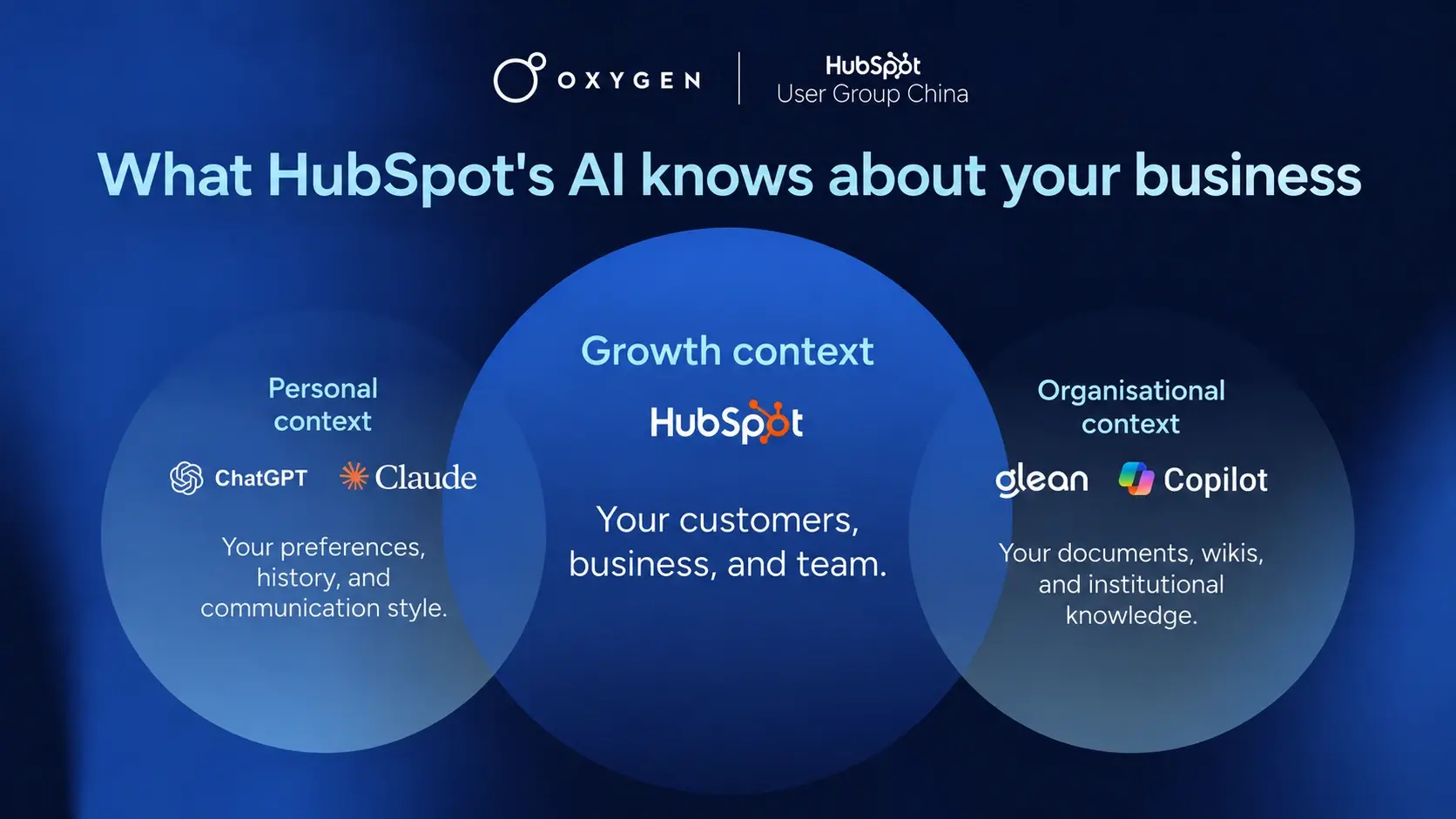
Growth Context is HubSpot's understanding of your company's business, team and customers. Its AI tools use that knowledge to produce responses and actions that reflect how your business actually operates.
It covers three areas:
- Business knowledge: products, positioning, competitors and brand voice.
- Team knowledge: sales methods, service processes, responsibilities and escalation rules.
- Customer knowledge: conversations, preferences, buying priorities and relationship history.
It also includes instructions on how to work: what belongs in a customer update, how to handle an urgent request, and when to ask for approval.
"HubSpot was very much a system of record: who's the contact, who's the deal, what stage is it at, who did we email. Now it's moving towards a system of context: what is your business strategy, who are your competitors, why do people buy from you, and why do they not buy from you?"
Gareth Jones, Managing Partner APAC, Oxygen · Watch at 12:48
A deal stage tells you where an opportunity stands. The customer's objections and priorities explain what to do next. Growth Context gives HubSpot's AI both, and it becomes more valuable as it accumulates, as long as it stays accurate. That is also why the model you use matters less than the context you give it.
How does Growth Context change HubSpot?
HubSpot has rebuilt its core tools around Growth Context, so the information captured in everyday work feeds directly into what happens next.
Four elements do the work:
- Self-updating Smart CRM: captures and syncs calls, emails and meetings, so records stay current with less manual entry. Data agents can then enrich and tidy those records, and the mobile note-taker captures conversations that happen outside formal meetings.
- Context Home: where teams review what HubSpot knows about the business, correct inaccuracies, and fill gaps. It also scores how complete your context is.
- Breeze Assistant: uses that context to answer questions, draft communications and complete tasks.
- Agent Hub and Agent Builder: let teams manage agents and build new ones for specific processes.
Together, they connect sales, marketing and service around one shared understanding of each customer.
Why does Growth Context matter for APAC businesses?
Businesses serving several APAC markets need AI that accounts for differences in language, customer expectations and operating processes. Growth Context is where those differences get written down.
Hong Kong and Mainland China show why:
- Different customers need different guidance. An overseas company setting up in Hong Kong asks different questions from a Mainland founder, and a referral partner needs a different level of detail from the client receiving the service.
- Language preferences shape every reply. Brand voice can be set separately for English, colloquial written Cantonese and Standard Written Chinese, with writing samples for each. Without them, Breeze can default to a generic style that sounds wrong to Hong Kong customers or too casual for formal Mainland communication. Each client’s record should also show whether they read Traditional or Simplified script.
- Processes vary by service and market. Filing deadlines, service levels and escalation rules determine which requests need attention first.
Without that context, a reply can sound polished but ask for the wrong documents or miss an urgent deadline.
Model access adds one more reason. Many Hong Kong users have recently lost access to Claude, while HubSpot's AI works without a VPN. When the model choice is partly made for you, context is what you control. If your team works from the Mainland, see which of the new AI features work in China.
How can businesses use Growth Context in HubSpot?
Teams can use context to support customer replies, prioritise service issues and prepare summaries for decision-makers. Gareth demonstrated all three with a corporate services firm built for the session. The company and its data were fictional, so treat these as illustrative examples.
| Use case | HubSpot tool | What it did | Watch it in action |
|---|---|---|---|
| Client replies | Breeze Assistant | Read recent messages and history, then drafted a reply covering what's received, outstanding and due | 28:21 |
| Ticket triage | Agent Builder | Flagged urgent tickets, such as a frozen bank account | 35:54 |
| Leadership summaries | Agent Builder | Sent the owner a brief of urgent issues, linked to each record | 39:53 |
"It's going to take unlearning and rethinking how we work. If we're always trying to do things the way we used to do them, that's really not going to fit the new agentic world."
Gareth Jones, Managing Partner APAC, Oxygen · Watch at 6:33
These tools change how work gets prepared and reviewed. Team members spend less time compiling updates by hand and more time reviewing drafts, acting on flagged priorities, and making judgement calls. That shift works best when everyone knows what good output looks like and who signs off on it.
How do you get started with HubSpot Growth Context?
Start with one recurring task and the knowledge behind it.
- Review what Context Home already holds. Check your value proposition, products, personas, competitors and brand voice, and clean the CRM records the task depends on. Our guide to data enrichment mistakes that break LLM workflows covers the common problems.
- Document what is missing. Add positioning, customer and process guidance, and assign an owner to keep each area current. A quick way in: gather your existing material and ask an AI model to interview you about the gaps.
- Choose one recurring task with a clear result. A client reply, a weekly service-priority summary or a list of deals needing follow-up all work. Specify which records to use, what the output should contain and which actions need approval.
- Test the output. Check accuracy, relevance and confidentiality before anything reaches a customer. Agent test runs do not use credits, so you can refine before you spend.
- Refine and measure. Track time saved after review, how often outputs need correcting and credit usage across the expected number of runs. For scale, when Gareth tested a compliance-brief agent, HubSpot estimated a run at about 369 credits, roughly US$3.70. Our guide to AI agents in Hong Kong and what they cost explains how HubSpot credits are priced.
"You should only ever use agents where you need some kind of human thinking. If something can be done in a workflow, do it in a workflow. It makes no sense to use those credits and an LLM for that kind of stuff."
Gareth Jones, Managing Partner APAC, Oxygen · Watch at 47:00
Predictable, rule-based steps belong in standard workflows: they run the same way every time and don’t need an LLM’s credits. Agents earn their place where a task needs interpretation, such as weighing several inputs to decide what is urgent.
Start with one process and the knowledge behind it
Pick one recurring task and write down what a capable employee needs to know to do it well: who the customer is, what good looks like, which rules apply and when to escalate. That list is the beginning of your Growth Context.
The same knowledge strengthens your marketing. Clear positioning and well-documented case studies help AI search tools recommend you, so AI search visibility and Growth Context reward the same work.
Want help choosing your first use case? Speak with one of our HubSpot experts about reviewing your Growth Context, or see how our HubSpot implementation and AI services teams can help.